
What if the safest place for your retirement nest egg isn’t a bank statement, but a high-security vault holding tangible assets? This question lies at the heart of a gold ira. Unlike traditional accounts filled with paper assets, this type of ira holds physical precious metals.
This fundamental difference brings a critical requirement: specialized, IRS-approved facilities. The IRS strictly prohibits keeping these assets at home. Your retirement savings must be held in a qualified depository to avoid penalties.
These facilities are fortresses. They feature Class III vaults, 24/7 surveillance, and comprehensive insurance. Understanding your Gold Storage & Depository Options for IRAs is the first step to true security.
Key Takeaways
- A Gold IRA holds physical assets, requiring secure, IRS-approved storage facilities.
- Storing your IRA’s physical gold at home is illegal and results in severe penalties.
- Approved depositories offer maximum security with features like vaults and armed guards.
- You can choose between segregated storage for your specific metals or commingled storage.
- Major providers include names like Delaware Depository, Brinks, and Texas Bullion Depository.
- Annual storage fees are a standard cost for protecting your investment.
- Some companies offer unique local viewing options for your holdings.
Get Your Free Precious Metals Information Kit

Introduction to Gold IRAs and Secure Storage
When traditional paper investments feel uncertain, many Americans turn to tangible assets for true security. Self-directed retirement accounts offer this unique opportunity.
Understanding the Basics of Gold IRAs
A gold ira is a special type of self-directed individual retirement account. Instead of stocks or bonds, it holds physical precious metals like silver, platinum, and palladium.
These metals serve as safe-haven assets during economic turbulence. They help protect your retirement savings from inflation and market swings.
The IRS sets strict purity standards for eligible metals. Your investment must meet specific fineness requirements to qualify.
Importance of Secure Storage for Your Retirement
You cannot keep these physical assets at home. The IRS requires professional storage in approved facilities to maintain tax benefits.
Custodians manage the relationship between you and the depositories. They handle compliance, insurance, and administrative tasks.
This professional protection ensures both your assets’ safety and your account’s legal status. Proper security is not optional—it’s essential.
| Feature | Traditional IRA | Self-Directed IRA |
|---|---|---|
| Asset Types | Stocks, bonds, mutual funds | Physical precious metals, real estate |
| Storage Location | Brokerage account | IRS-approved depository |
| Tax Benefits | Tax-deferred growth | Same tax advantages |
| Diversification | Market-based only | Physical asset protection |
Regulatory Requirements and IRS Guidelines
The IRS has established clear protocols to ensure the safety and legitimacy of physical asset holdings in retirement portfolios. These rules protect your investment while maintaining tax advantages.
IRS Approved Depositories and Storage Rules
Section 408 of the Internal Revenue Code mandates specific requirements for holding metals in retirement accounts. Your assets must stay in IRS-approved facilities.
Approved depositories include major names like Delaware Depository, Brinks, and Texas Bullion Depository. These facilities meet strict security and insurance standards.

Both segregated and commingled storage options comply with IRS rules when using approved facilities. Custodians conduct regular audits to verify compliance.
Consequences of Non-Compliance
Attempting home storage triggers severe penalties. The IRS treats your entire gold iras as a distribution.
This means immediate income tax on the full value. Investors under 59½ face an additional 10% early withdrawal penalty.
These rules exist to protect your retirement savings. Proper storage ensures your assets remain secure and insured.
| Storage Type | Tax Status | Legal Compliance |
|---|---|---|
| IRS-Approved Facility | Tax-Deferred Growth | Fully Compliant |
| Home Storage | Immediate Taxation | Violation |
| Non-Approved Facility | Distribution Treatment | Non-Compliant |
Understanding these requirements helps avoid costly mistakes with your retirement accounts. Always work with qualified custodians for your ira investments.
Gold Storage & Depository Options for IRAs
The landscape of IRS-approved storage solutions offers multiple pathways for protecting your tangible retirement holdings. Investors can choose from three main categories of secure facilities.
Bank-affiliated vaults provide institutional backing. Major financial institutions like HSBC Bank USA and JP Morgan Chase operate these facilities. They leverage existing security infrastructure and insurance relationships.
Independent precious metals depositories specialize exclusively in bullion storage. Companies like Delaware Depository and Texas Bullion Depository focus on this niche. They often offer transparent fee structures tailored to metals investors.
Best Precious Metals Companies of 2026
Three top picks to compare quickly—minimums, fees, eligible metals, and what each provider does best.

- Minimum$50,000
- Annual Fees$180
- MetalsGold, Silver
Best for: education-first buyers who want guided support.
Get Free Gold IRA Kit
- Minimum$10,000
- Annual Fees$180
- MetalsGold, Silver, Platinum, Palladium
Best for: clear, straightforward fee expectations.
Get Free Info Kit
- Minimum$25,000
- Annual Fees$225
- MetalsGold, Silver, Platinum, Palladium
Best for: value shoppers who want competitive pricing.
Request Free Info KitPrivate vault companies provide boutique services with additional flexibility. Options from Loomis International or Malca-Amit may feature specialized security. Careful vetting ensures these facilities meet IRS approval requirements.
Beyond facility types, you’ll choose between segregated and commingled storage arrangements. Geographic location also matters with domestic options in states like Wyoming and Texas. International facilities through global operators like Brinks offer geopolitical diversification.
All approved depositories feature robust security measures. These include Class III vaults, 24/7 surveillance, and comprehensive insurance coverage. Your retirement assets receive maximum protection in these professional environments.
Segregated vs. Commingled Storage: Key Differences
Choosing how your physical assets are safeguarded involves a fundamental decision between two distinct approaches. Each method offers unique advantages for protecting your retirement portfolio.
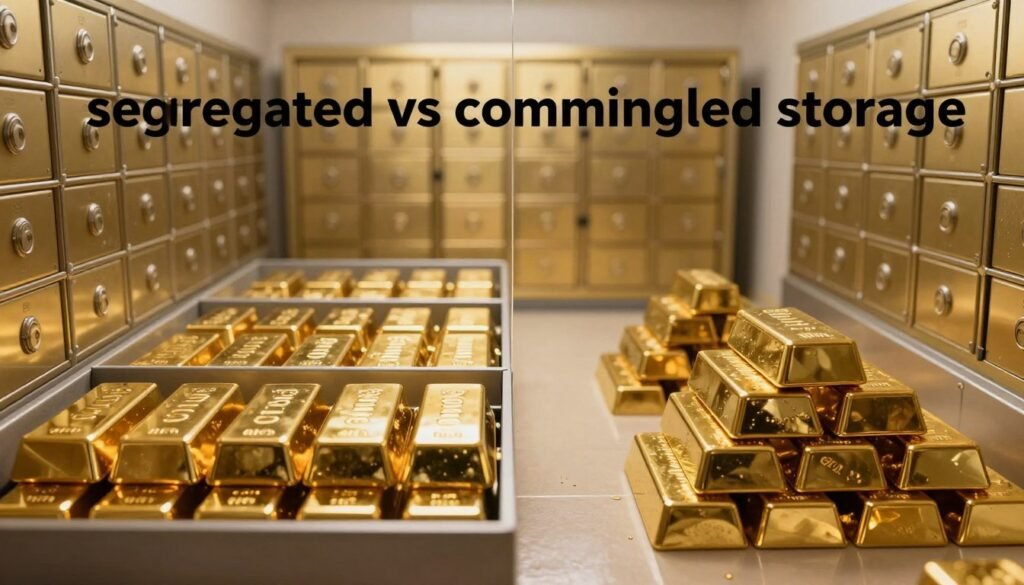
Understanding these differences helps you select the best arrangement for your specific needs and priorities.
Direct Ownership with Segregated Storage
Segregated storage provides complete control over your specific assets. Your bullion pieces receive individual identification with serial numbers.
This approach ensures you receive the exact items you purchased upon withdrawal. The clear distinction simplifies auditing processes significantly.
Investors appreciate the transparency and certainty this method offers. It’s particularly valuable for substantial portfolios requiring maximum control.
Cost Efficiency and Shared Storage Benefits
Commingled storage pools metals from multiple investors in shared vault space. This shared approach reduces annual fees substantially.
While you won’t receive your original pieces upon distribution, you get equivalent metals of identical purity. The cost savings make this an attractive option for many.
Both storage methods meet IRS standards and provide robust security features. Your choice depends on whether you prioritize control or cost efficiency.
Evaluating Top-Tier Depositories and Custodians
Not all facilities protecting retirement metals offer the same level of security. Discerning investors need to know what separates exceptional providers from average ones. The right partnership ensures your assets receive maximum protection.
Security Features to Look For
Top-tier facilities feature Class III vaults with the highest security ratings. These vault systems provide impenetrable protection for your precious metals. They represent the gold standard in physical asset security.
Around-the-clock surveillance systems monitor every movement. Biometric access controls ensure only authorized personnel can enter. Armed guards and dual-control procedures add extra layers of protection.
Comprehensive insurance from providers like Lloyd’s of London covers all risks. This protection gives investors peace of mind knowing their assets are fully covered.
Transparency and Audit Practices
Reputable custodians conduct regular audits of your holdings. Third-party verification ensures complete accuracy. This transparency builds trust between you and your storage provider.
Leading companies like Delaware Depository and Texas Bullion Depository offer real-time account access. Investors can verify their gold holdings anytime. This level of openness distinguishes top-performing depositories.
Regular reporting and identity verification maintain account integrity. These practices ensure your retirement metals remain secure and properly documented.
Best Precious Metals Companies of 2026
A quick side-by-side snapshot of minimums, fees, and what makes each provider stand out—so you can choose faster and request a free kit.
Birch Gold Group
Augusta Precious Metals
Noble Gold Investments
GoldenCrest Metals
Lear Capital
Storage Fees and Cost Considerations
Different providers offer varied fee structures that affect the total expense of maintaining your account. Understanding these costs helps you make informed decisions about your retirement planning.
Annual charges typically range from $100 to $300. The type of arrangement you choose impacts your total costs significantly.
Comparing Annual, Setup, and Transaction Fees
Providers use different pricing models. Some companies charge percentage-based fees tied to your holdings’ value. Others offer flat-rate structures that benefit investors with larger accounts.
American Hartford Gold waives setup and transfer fees entirely. Their annual costs include a $50 custodian fee and $100 for secure facilities. This transparent approach helps investors budget accurately.
Birch Gold Group uses a flat-rate system that becomes more economical as your portfolio grows. Noble Gold charges $80 for account maintenance plus $150 for insurance and individual storage annually.
Transaction fees for buying or selling metals add to your total expenses. Some providers also charge for withdrawals or account closures. Always ask for a complete fee breakdown before opening your account.
Unique Advantages of Domestic Storage Solutions
Domestic depositories eliminate the complexities of cross-border regulations while offering faster access to your assets. American facilities provide practical benefits that international options simply cannot match.
Choosing locations within the United States means avoiding customs delays and foreign legal hurdles. Your metals remain under U.S. jurisdiction with clear regulatory protection.
Accessibility and Faster Withdrawals
Domestic facilities offer superior accessibility for retirement account holders. Providers like BlueVault maintain locations in Dallas, Orange County, and San Diego where clients can schedule personal viewings.
This hands-on access provides peace of mind that distant international facilities cannot offer. You can verify your holdings directly rather than relying solely on documentation.
Withdrawal processes become significantly faster with domestic arrangements. Distributions can be processed within days using expedited domestic shipping or local pickup options.
Geopolitical risks diminish when your assets stay within U.S. borders. Foreign government actions or international instability won’t impact your retirement security.
Cost efficiency improves with lower transport fees and simplified coordination between custodians and depositories. All parties operate under the same legal framework, streamlining administrative processes.
Innovative Storage Options from Leading Providers
Today’s savvy investors expect direct access and complete visibility of their assets. Forward-thinking companies now offer solutions that bridge the gap between maximum security and personal verification.
Get Your Free Precious Metals Information Kit
Local Storage Benefits with Insured Vaults
BlueVault stands out with depository-grade facilities in Dallas, Orange County, and San Diego. Clients can personally inspect their bullion at these local locations.
The company uses segregated storage exclusively. Your precious metals remain individually identified and never mixed with other investors’ holdings.
AXA provides comprehensive insurance coverage for all assets. This global underwriter also protects cultural treasures like the Sistine Chapel, demonstrating their reliability.
Real-Time Audits and Customer Transparency
Modern technology enables ongoing verification rather than annual checks alone. Investors appreciate this constant oversight of their retirement portfolio.
Augusta Precious Metals partners with Delaware Depository while offering extensive educational resources. Goldco coordinates with Brinks and is renowned for exceptional customer service.
Noble Gold provides diverse solutions including its own Texas facility. Advantage Gold maintains outstanding satisfaction ratings with nearly 1,800 TrustPilot reviews showing 98% five-star feedback.
These companies understand that transparency builds trust. They empower investors with knowledge and access throughout the storage process.
Best Practices for Safeguarding Your Retirement Assets
Your retirement future depends on making smart decisions about where and how your physical assets are stored. Implementing proven security measures ensures your hard-earned savings remain protected through market changes.
Start by selecting facilities with Class III vaults and comprehensive surveillance systems. These features represent the highest security standards available. Always verify insurance coverage from reputable providers like Lloyd’s of London.
Implementing Secure Vault Features
Top-tier facilities offer multiple layers of protection. Look for biometric access controls and armed security personnel. These elements work together to create an impenetrable environment.
Choose established custodians with strong track records. Companies like Equity Trust Company and STRATA Trust Company provide reliable service. Their experience helps navigate complex regulations.
Conduct regular account reviews and audit verifications. This ongoing vigilance ensures your holdings remain properly documented. Stay informed about any operational changes.
Consider your storage choice carefully. Segregated arrangements offer maximum control for larger portfolios. Commingled options provide cost efficiency for smaller accounts.
Financial experts typically recommend limiting precious metals to 5-10% of your retirement portfolio. This diversification strategy helps balance growth with stability. Your self-directed ira becomes a powerful hedge against uncertainty.
Conclusion
Securing your retirement future requires careful planning and the right protective measures for your hard-earned savings. This guide has shown that proper asset protection is not just a preference—it’s an essential requirement for maintaining your account’s legal status and tax advantages.
Remember the key choices available for your precious metals. Segregated arrangements offer maximum control, while commingled solutions provide cost efficiency. Top-tier security features like Class III vaults and comprehensive insurance are non-negotiable for true peace of mind.
Working with established companies ensures your investment receives professional care. The right custodian partnership makes all the difference in safeguarding your retirement portfolio through proper metal holdings protection.