
What if you could own a piece of history that also protects your future? For thousands of years, civilizations have valued certain rare materials. These tangible assets have stood the test of time, offering a unique way to build and preserve wealth.
This resource is designed for everyone. Whether you’re just starting or looking to deepen your knowledge, we break down complex ideas into simple terms. You will learn how to add these powerful tools to your financial plan.
We will explore the distinct roles of gold, silver, platinum, and palladium. You’ll discover how they can act as a shield against inflation and market swings. Our friendly guide covers everything from physical bars to modern investment funds.
Key Takeaways
- Precious metals have been a trusted store of value for centuries across different cultures.
- They offer a practical method for diversifying your portfolio and managing risk.
- These assets can provide a hedge against inflation and economic uncertainty.
- Investment options range from owning physical metal to buying shares in funds and mining companies.
- Understanding the unique properties of each metal is key to a successful strategy.
- This guide simplifies the process, making it accessible for investors at any level.
Best Precious Metals Companies of 2026
Three top picks to compare quickly—minimums, fees, eligible metals, and what each provider does best.

- Minimum$50,000
- Annual Fees$180
- MetalsGold, Silver
Best for: education-first buyers who want guided support.
Get Free Gold IRA Kit
- Minimum$10,000
- Annual Fees$180
- MetalsGold, Silver, Platinum, Palladium
Best for: clear, straightforward fee expectations.
Get Free Info Kit
- Minimum$25,000
- Annual Fees$225
- MetalsGold, Silver, Platinum, Palladium
Best for: value shoppers who want competitive pricing.
Request Free Info KitUnderstanding Precious Metals: Historical Significance and Modern Appeal
Long before digital currencies and stock markets, civilizations built their wealth on tangible treasures that have stood the test of centuries. These rare materials have consistently maintained their appeal across different eras and cultures.
Historical Overview of Precious Metals
Ancient societies valued gold and silver for their rarity and beauty. People used them as currency and symbols of power. Their durability made them perfect for preserving wealth over time.
These assets were prized across cultures without needing government backing. Their inherent worth was universally recognized. This historical foundation explains their lasting appeal.
Modern Relevance in Investment Portfolios
Today, these assets serve as sophisticated tools for wealth protection. They offer unique advantages that paper currencies cannot match. Their intrinsic value doesn’t depend on any institution’s promise.
One key benefit is their low correlation with stocks and bonds. This means they often move independently during market changes. Even a small allocation can significantly reduce portfolio risk.
| Characteristic | Historical Role | Modern Application | Key Benefit |
|---|---|---|---|
| Rarity | Symbol of status and power | Hedge against inflation | Limited supply |
| Durability | Long-term wealth storage | Portfolio diversification | Preserves value over time |
| Universal Recognition | Cross-cultural currency | Global investment asset | No credit risk |
| Intrinsic Value | Independent of rulers | Protection against currency devaluation | Cannot be printed artificially |
Understanding both historical context and current applications helps investors make informed decisions. These assets continue to offer unique protection in uncertain economic climates.
Market Dynamics and Price Drivers for Precious Metals
Several key drivers influence how much these valuable resources are worth in today’s markets. Unlike stocks or bonds, their value responds to a unique mix of industrial needs, investor sentiment, and global economic conditions.
Supply and Demand Factors
The basic rule of supply and demand plays a big role. New supply mainly comes from mining and recycling efforts. Demand comes from jewelry, industrial uses, and investment purposes.
Each material reacts differently to these pressures. Gold’s price is less tied to new mining supply because so much already exists above ground. Silver and platinum are more sensitive to production changes due to their industrial applications.
Impact of Geopolitical and Economic Issues
Political instability can seriously affect prices. Conflicts or trade disputes may disrupt supply chains, especially for materials mined in concentrated regions. This often drives investors toward safer assets.
Economic factors like inflation and interest rates also matter. When traditional investments offer low returns or currencies weaken, these assets become more attractive. This creates price volatility as market sentiment shifts.
Successful investing requires watching multiple indicators. Different materials respond to different economic signals, creating both opportunities and risks in the market.
Precious Metals Investing 101: Complete Guide
The world of asset allocation offers diverse pathways for safeguarding your financial future against market volatility. These tangible assets provide unique opportunities beyond traditional stocks and bonds.
Each of the four main precious metals serves distinct purposes in a portfolio. Understanding their characteristics helps investors make informed choices.
| Metal | Primary Role | Key Characteristic | Investor Profile |
|---|---|---|---|
| Gold | Wealth preservation | Time-tested safe haven | Risk-averse investors |
| Silver | Dual investment/industrial | Higher volatility potential | Growth-oriented investors |
| Platinum | Industrial & investment | Extreme rarity | Advanced investors |
| Palladium | Emerging opportunity | Strong industrial demand | Speculative investors |
Get Your Free Precious Metals Information Kit

“Diversification is the only free lunch in investing.”
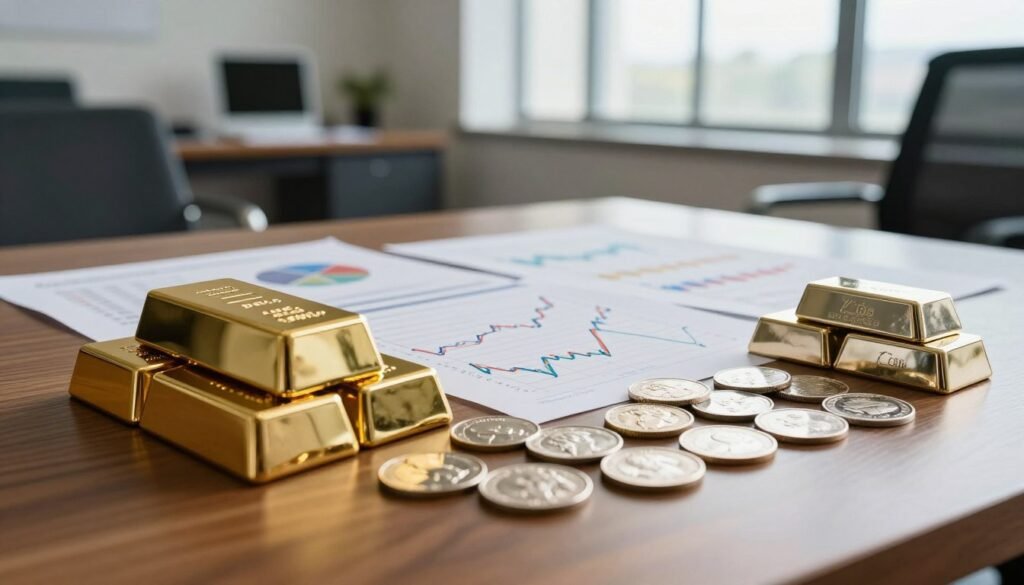
Investors have multiple options for gaining exposure to these assets. Physical ownership through bars and coins provides direct control. Exchange-traded funds (ETFs) offer convenience and liquidity.
Mining stocks represent another popular choice among investment products. These companies’ performance can amplify metal price movements. Futures and certificates provide additional alternatives for sophisticated investors.
There’s no single approach that works for everyone. Your strategy should match your personal goals and risk tolerance. Most experts suggest allocating 5-15% of a portfolio to these assets.
This balanced approach provides protection without sacrificing growth potential. The following sections will explore each metal and investment method in detail.
Exploring Gold as a Time-Tested Investment
When economic storms gather, investors instinctively turn to a familiar yellow metal for protection. Gold’s unique physical properties—it doesn’t rust or corrode, is highly malleable, and conducts electricity—make it durable across centuries. Though it has industrial uses, people primarily value it as a store of value.
Gold as a Safe Haven in Times of Crisis
Throughout history, gold has served as financial insurance during banking crises, currency collapses, and political upheaval. Its value comes from universal recognition rather than government promises. This makes it resilient when traditional systems falter.
Central banks worldwide hold massive reserves, with the U.S. maintaining 8,133.5 tons as of August 2024. This institutional confidence reinforces gold’s role as a hedge against inflation and geopolitical stress.
Key Factors Influencing Gold Prices
Gold’s price behaves differently than other commodities. Since existing above-ground stocks dwarf annual mining output, investor sentiment drives movements more than supply-demand dynamics. Market psychology and hoarding behavior significantly impact valuations.
The metal trades 24/7 globally, creating high liquidity. However, gold carries risks—it generates no income, can stagnate during stable periods, and requires secure storage for physical holdings.
Many investors combine gold silver holdings to capture different market dynamics. While gold remains the primary safe-haven asset, silver offers additional industrial exposure and volatility potential.
Silver: Dual Role as Investment and Industrial Metal
While gold often steals the spotlight, silver offers investors a unique combination of wealth protection and economic growth exposure. This versatile metal serves two masters, creating fascinating price dynamics.
Industrial Applications Driving Silver Demand
Roughly half of all silver demand comes from industrial uses. This creates a strong foundation for the metal’s value beyond just investment appeal.
Modern technology relies heavily on silver’s exceptional conductivity. It’s essential in solar panels, electronics, and medical devices. New applications continue to emerge as technology advances.
| Application Sector | Percentage of Demand | Growth Trend | Key Driver |
|---|---|---|---|
| Industrial Uses | 50% | Increasing | Technology advancement |
| Jewelry & Silverware | 25% | Stable | Cultural preferences |
| Investment Demand | 25% | Variable | Market conditions |
Investment Insights and Volatility in Silver
Silver’s smaller market size contributes to its higher price swings compared to gold. This volatility can create both risks and opportunities for investors.
“Silver is the only metal that is both a precious and industrial commodity, giving it a unique investment profile.”
The metal often moves with gold during economic uncertainty. However, industrial demand can push prices independently during economic growth periods. This dual nature makes timing important.
Silver appeals to investors seeking exposure to both safe-haven assets and economic growth. Its lower price point also makes it more accessible than gold for smaller portfolios.
In-Depth Look at Platinum: Rarity and Industrial Demand
Among the elite group of valuable resources, platinum stands out for its extraordinary scarcity and industrial importance. This precious metal often commands higher prices than gold during stable market periods because far less is mined annually.
Best Precious Metals Companies of 2026
A quick side-by-side snapshot of minimums, fees, and what makes each provider stand out—so you can choose faster and request a free kit.
Birch Gold Group
Augusta Precious Metals
Noble Gold Investments
GoldenCrest Metals
Lear Capital
Its extreme rarity makes supply vulnerable to disruptions. This creates unique investment opportunities and risks.
Automotive Catalysts and Other Industrial Uses
Platinum’s primary demand comes from automotive catalysts that reduce harmful emissions. This application accounts for about one-third of total consumption. The metal’s performance directly ties its value to the automotive industry’s health.
Other significant uses include jewelry, petroleum refining, and medical devices. Emerging technologies like hydrogen fuel cells also rely on this versatile metal.
| Application Sector | Percentage of Demand | Growth Potential |
|---|---|---|
| Automotive Catalysts | 33% | Moderate |
| Jewelry | 25% | Stable |
| Industrial Applications | 42% | High |
Geopolitical Influences on Platinum Supply
Platinum mining concentrates heavily in South Africa and Russia. This geographic limitation creates supply chain risks. Political instability or labor disputes can significantly impact availability.
The COVID-19 pandemic provides a clear example of supply-demand dynamics. Vehicle production drops pushed the price down temporarily. Then recovery caused a 21% demand surge in early 2021.
“Platinum’s industrial focus makes it respond differently to economic signals than traditional safe-haven assets.”
Some manufacturers substitute palladium in catalysts, creating evolving competition. This precious metal suits investors comfortable with volatility and those bullish on clean energy technologies.
The Emerging Role of Palladium in Your Portfolio
Often overlooked in favor of its more famous cousins, palladium quietly powers much of our modern world. This shiny, silvery metal (atomic number 46) combines unique physical properties with crucial industrial applications.
Palladium becomes stronger when worked at room temperature, making it ideal for specialized manufacturing. Its malleability allows workers to create sheets as thin as one-two hundred fifty thousandths of an inch.
Industrial Applications and Investment Potential
The automotive sector drives approximately 80% of global palladium demand. This precious metal serves as an efficient catalyst in converters, scrubbing harmful emissions from gasoline engines.
Beyond vehicles, palladium appears in electronics, dentistry, medicine, and jewelry. Jewelers first used it in 1939, creating alloys stronger than white gold. The metal also plays roles in solar energy systems and fuel cells.
Supply concentration creates interesting dynamics for this investment. Russia and South Africa dominate production, with smaller contributions from North America and other regions. This geographic focus introduces geopolitical considerations that can affect the metal’s price.
Palladium’s close relationship with platinum adds another layer. These chemical cousins often come from the same mines but serve different automotive applications. While platinum works better in diesel engines, palladium excels in gasoline vehicles.
Historical examples show palladium’s versatility. Tonga issued the first palladium coins in 1967 for a royal coronation. This demonstrated early recognition of the metal’s value beyond industrial uses.
For investors, palladium offers exposure to automotive industry trends and emissions regulations. Its price reflects balancing acts between vehicle production, electric vehicle adoption, and environmental standards. This metal suits those comfortable with volatility driven by concentrated industrial demand.
Diversification Strategies: Incorporating Multiple Precious Metals
The true power of diversification emerges when investors combine different valuable resources rather than relying on just one. Just as spreading investments across stocks and bonds reduces risk, holding multiple metals can optimize your portfolio’s performance.
Benefits of a Mixed-Metal Portfolio
Each metal responds differently to economic conditions. Gold typically shines during crises, while silver benefits from industrial growth. Platinum and palladium follow manufacturing trends.
This creates natural balance within your asset allocation. When one metal underperforms, others may excel. The result is smoother long-term returns.
| Metal | Primary Strength | Economic Condition | Risk Profile |
|---|---|---|---|
| Gold | Stability & safety | Inflation/crisis | Low volatility |
| Silver | Growth potential | Economic expansion | Moderate-high |
| Platinum | Industrial demand | Manufacturing growth | Moderate |
| Palladium | Emerging technology | Auto industry trends | High volatility |
“Diversification is a protection against ignorance. It makes little sense if you know what you are doing.”
Most advisors suggest allocating 5-15% of your portfolio to these assets. The exact amount depends on your risk tolerance and investment timeline.
You can build exposure through individual positions or basket ETFs. Regular rebalancing ensures your mix stays aligned with market conditions.
Investment Vehicles for Precious Metals
Modern investors have multiple pathways to gain exposure to gold, silver, and other valuable commodities. Each option serves different needs and preferences.
The right choice depends on your priorities. Consider convenience versus direct ownership, liquidity versus control, and cost versus security.
ETFs, Mutual Funds, and Mining Stocks
Exchange-traded funds (ETFs) provide a popular way to invest without handling physical assets. They trade like stocks and offer instant exposure to price movements.
Mining stocks and mutual funds add another layer. These investments can amplify gains when prices rise. They also introduce company-specific risks.
| Vehicle Type | Access Method | Liquidity Level | Cost Considerations |
|---|---|---|---|
| ETFs | Stock exchange | High | Low expense ratios |
| Mining Stocks | Brokerage account | High | Standard trading fees |
| Mutual Funds | Fund company | Moderate | Management fees |
| Options/Futures | Derivatives market | High | Commission-based |
Get Your Free Precious Metals Information Kit
Physical Ownership Versus Digital Options
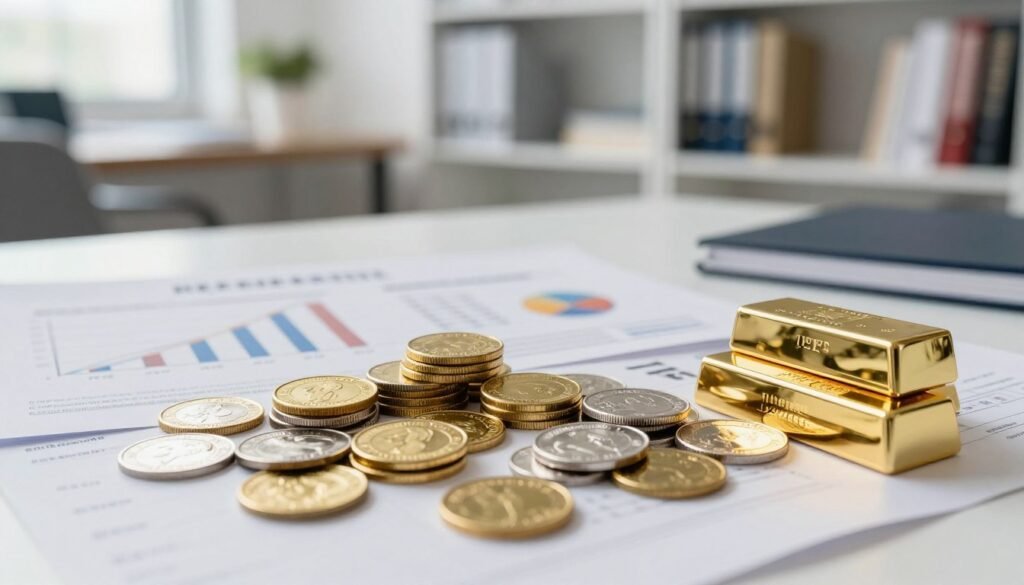
Bullion and coins represent the most direct way to own these assets. You hold tangible bars or recognized government-issued coins.
This approach requires secure storage solutions. Home safes or bank deposit boxes add to the overall cost.
Digital certificates offer a middle ground. They provide ownership claims without storage hassles. Investors must trust the issuing institution’s security.
Beginners often start with ETFs for convenience. As knowledge grows, many add physical coins to their strategy.
Weighing Risks and Rewards in Precious Metals Investments
Smart investors always weigh the upside potential against the downside exposure before committing capital. While these assets offer unique protection benefits, they also carry specific risks that require understanding.
Every allocation decision involves balancing potential gains with possible losses. A thoughtful approach helps manage expectations and build resilience.
Understanding Price Volatility and Storage Concerns
Price swings represent a significant risk for investors. These assets can experience rapid changes due to supply shifts or market sentiment.
Unlike dividend-paying stocks, they generate no income. Investors rely entirely on price appreciation for returns.
Physical ownership introduces storage challenges. Secure storage solutions add to the total cost of maintaining these positions.
Liquidity can vary significantly between investment forms. While ETFs trade easily, physical bullion may require finding buyers.
Market timing presents another challenge. Prices may remain flat during favorable conditions, testing investor patience.
Concentration risk emerges when allocating excessive amounts. Most advisors suggest limiting exposure to 5-15% of portfolio value.
This balanced approach helps manage volatility while capturing diversification benefits. Understanding these risks empowers better decision-making.
Strategies for Long-Term Wealth Preservation with Precious Metals
Building lasting financial security requires strategies that withstand economic cycles and preserve purchasing power over decades. These tangible assets serve as powerful tools for maintaining your financial foundation.
Hedging Against Inflation and Currency Debasement
When inflation erodes the purchasing power of paper currency, these assets maintain their intrinsic value. Governments cannot create more of them through printing presses.
This makes them effective protection against currency debasement. As money supplies expand, tangible assets often appreciate relative to fiat currencies.
During periods of negative real returns, people naturally seek assets that preserve wealth. These resources provide that essential stability.
Balancing Risk Through Diverse Investment Options
Successful investors understand the importance of diversification within their portfolio. Different investment vehicles offer unique advantages.
Physical holdings provide direct ownership insurance. Exchange-traded funds offer liquidity and convenience for active investments.
A balanced approach combines various options to manage risk effectively. Most financial advisors recommend allocating 5-15% of your portfolio to these assets.
This strategic mix helps protect your wealth while allowing growth in other investment areas. The key is maintaining discipline through market fluctuations.
Best Precious Metals Companies of 2026
Three top picks to compare quickly—minimums, fees, eligible metals, and what each provider does best.
- Minimum$50,000
- Annual Fees$180
- MetalsGold, Silver
Best for: education-first buyers who want guided support.
Get Free Gold IRA Kit
- Minimum$10,000
- Annual Fees$180
- MetalsGold, Silver, Platinum, Palladium
Best for: clear, straightforward fee expectations.
Get Free Info Kit
- Minimum$25,000
- Annual Fees$225
- MetalsGold, Silver, Platinum, Palladium
Best for: value shoppers who want competitive pricing.
Request Free Info KitConclusion
Building a resilient financial future often involves looking beyond traditional stocks and bonds. The world of precious metals offers a time-tested way to diversify your approach and protect your wealth.
Each metal brings unique strengths to your portfolio. Gold serves as a stable anchor during uncertain times. Silver combines industrial demand with investment appeal. Platinum offers rarity and specialized applications.
The right investment strategy depends on your personal goals and risk tolerance. Most experts suggest allocating 5-15% of your total asset amount to these resources. Various products like ETFs and physical bullion provide flexible options.
Every investor can find an approach that matches their financial objectives. With proper understanding, these valuable resources become powerful tools for long-term security and growth.